
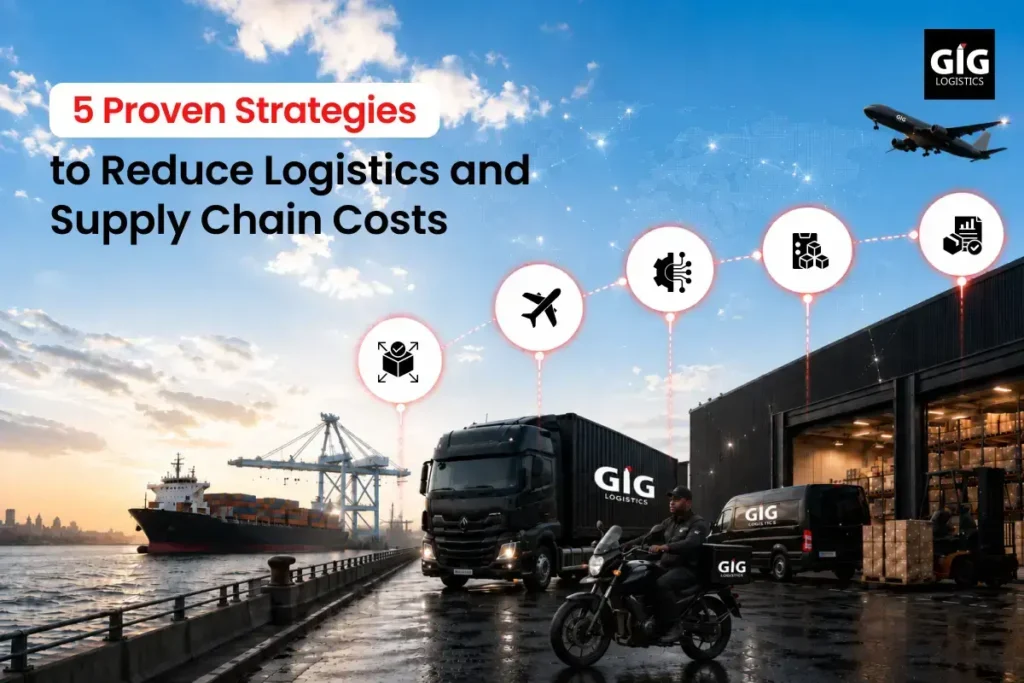
5 Proven Strategies to Reduce Logistics and Supply Chain Costs
Logistics costs can significantly affect a business’s profit margin, especially when transportation, warehousing, inventory, labour, and shipping costs continue to rise. For businesses transporting goods locally or internationally, reducing logistics costs requires more than just negotiating low freight rates. It will require implementing a systematic process that enhances efficiency while maintaining speed and customer satisfaction. But how can companies reduce logistics costs? The best way to reduce logistics costs is by improving five key aspects of the supply chain. 5 Strategies To Reduce Your Logistics & Supply Chain Costs In the complex area of supply chain management, cutting down the cost of logistics while maintaining client satisfaction requires continuous compromise. This challenge emerges from how best one can reduce avoidable costs without impacting product quality, delivery speed, or service levels. To help business entities find this perfect balance, below are five effective supply chain cost-reduction strategies which can significantly reduce logistics costs without reducing the quality of service. Improve Warehouse Optimization Warehouses can experience huge costs when it comes to rent, utilities, labor, storage, handling, and even inventory carrying. Poorly run warehouses could cause delays in ordering, picking mistakes, and even unnecessary handling of products. Begin optimizing your warehouse operations by looking at how the products come into your warehouse, get stored in your warehouse, and are finally sent out from the warehouse. Products that have higher demands need to be placed near packaging and shipping areas. Businesses should also review their warehouse layout to eliminate unnecessary movement and improve employee productivity. For warehouse cost reduction, businesses should regularly evaluate their storage. Slow-moving items may occupy valuable locations that can be used for fast-moving products. Effective inventory management would not only help organizations maintain an efficient stock level but would also minimize unnecessary storage costs. Technology can also improve warehouse operations through tools such as barcode scanning, warehouse management software, automated inventory systems, and automated order processing. Transportation Improvement and Route Optimization Transportation is often one of the largest components of logistics costs. Fuel prices, carrier charges, delivery distances, vehicle capacity, and last-mile delivery expenses can all affect the total cost of transportation. Effective transportation planning begins with reviewing shipment patterns. Analyzing delivery locations, shipment sizes, order frequency, carrier effectiveness, and type of transport used should give insight into carrier selection and when premium transportation services may be needed. Route optimization can also decrease mileage, fuel cost, and delivery time. Where possible, businesses can group deliveries based on geographic location and select routes according to distance, traffic conditions, delivery windows, and vehicle capacity. For international deliveries, businesses also need to carefully consider the right method of transport. Air and sea freight can be compared based on urgency, shipment volume, destination, and budget. Companies handling international shipping services for businesses can check if consolidated deliveries provide better value than individual deliveries. Use Supply Chain Automation Manual processing may be tedious and may entail some avoidable errors. Employees may take several hours in manually processing order information, inventory update, documentation process, or status update of shipments. Supply chain automation can help make these processes more efficient. Companies may automate order, inventory and shipment tracking, documentation and communications with carriers. The technology may assist companies in integrating their systems and exchange data between the sales, warehouse, transportation, and finance departments. Real-time visibility is especially important for logistics operations. Real-time shipment tracking will allow companies to obtain information and detect possible issues before it affects their customers. Visibility will also improve customer communication and reduce response times for shipment related inquiries. However, automation should be based on the practical results obtained by companies. Prior to implementation of new technologies, companies should determine what processes take the most time or entail the largest errors or expenses. Improve Supplier and Inventory Management Supplier relationships have an impact on the costs of purchasing, transporting, inventory holding, and production costs. Efficient supplier management goes beyond price quotations. Companies need to consider factors such as lead time, minimum order quantity, product quality, delivery reliability, payment terms, and service performance. Conducting regular supplier reviews may help a business see ways to achieve a better price or flexibility in purchasing goods. Also, there is an opportunity to concentrate purchases with reliable suppliers, provided doing so does not create unnecessary supply risks. Effective inventory management is another key element. Having too much inventory means that the company loses money, having too little causes urgent ordering and paying extra fees. The inventory levels must be determined according to the company’s needs, lead times, and supplier dependability. Slow-moving items must also be analyzed periodically so that procurement policy may be adjusted depending on the situation. This approach will ensure logistics cost management while maintaining customer service level. Make Data-Driven Logistics Decisions Cost-saving initiatives become easier for companies if they regularly measure their performance. Instead of making assumptions, companies can use data to understand where money is being spent and determine whether operational changes are producing measurable results. Some useful logistics KPIs include: Cost per shipment Warehouse cost per order Order accuracy Inventory turnover Delivery timelines Fuel usage Carrier performance Average delivery time Through data-driven logistics decision-making, organizations can make decisions based on the performance measures instead of assumptions. For example, a carrier with slightly higher rates may provide greater overall value if it has better delivery performance and generates fewer claims, damages, or delays. Companies need to analyze KPIs on a regular basis as opposed to analyzing costs only when there is budgetary pressure. Consistent measurement creates a clearer picture of operational performance and supports continuous supply chain efficiency. How to Build a Sustainable Cost Reduction Plan Businesses should not consider making changes to every logistics process at once. Start by determining where the major costs are coming from and determine your current baseline. Then you can choose one or two areas that will have an impact. For instance, you may begin with changing the layout of your warehouse and then introduce an automatic inventory management system. You may also concentrate on transport